what to highlight about the European LegalTech Congress?
as always, people


The European LegalTech Congress 2019, promoted by the European LegalTech Association (ELTA), was held in Madrid.
ELTA is an association focused on innovation, digital transformation of the legal sector and LegalTech. It is made up of lawyers, academics, businessmen and students from all over Europe. And, it is growing.
As a partner in the organization of the Congress, I can say that the project was very ambitious in many ways, but thanks to the people, it was a great success.
This year ELTA held its Annual General Meeting of members on 20 November, kindly hosted by Eversheds Sutherland at its headquarters. There, ELTA members addressed several challenges:
At internal level, on how ELTA can bring greater value to its partners in the current environment and with the dimension that the partnership is taking on. The meeting was led by ELTA President and Vice President Tobias Heining and María Jesús González Espejo.
In general terms, about the ethical issues to be considered in the development of technology and, in particular, in the use of Artificial Intelligence, in which a technologist from the Artificial Intelligence Network association and researcher from the Universidad Europea, Esteban García, was invited,
And, from a social standpoint, by ELTA's signing of the Barcelona Digital Rights Charter with María Eugenia Gay, Dean of the Barcelona Bar Association (ICAB). Many of the lawyers present, coming from different countries, were pleasantly surprised by the Dean's openness and vision in the protection of fundamental rights without slowing down technological progress. Her words were undoubtedly an example for many bar associations throughout Europe if they would really want to bet on the lawyer of the future.
On November 21, the first open day of the Congress took place at the Universidad CEU San Pablo, which hosted and inaugurated it, with the intervention of Carlos del Valle, Dean of the Faculty of Law accompanied by José María Alonso, Dean of the Bar Association of Madrid (ICAM). The support of this academic institution and the Madrid Bar Association are also proof of the importance of continuing education in the life of a lawyer. You can never stop learning.
The undoubted protagonists of the Congress were the public, more than 300 attendees from 33 countries and 5 continents, and the speakers, experts from the entire legal ecosystem. As I cannot be fair with all speakers herein, I would like to invite the reader to visit the website of the Congress and its program so that he can personally check himself.
The Congress was structured in 3 pillars: people, processes and platforms. All of them were approached from different points of view in different round tables and presentations. There was unanimity: first of all the people. Jorge J. Vega-Iracelay, a former Microsoft corporate Chief Counsel, professor and current researcher, stated that "the first thing is to equip the lawyer with business skills and foster an innovative culture".
The objective of the Congress is to make it truly international and to serve as a bridge between the European and Latin American LegalTech communities. For this reason, it was developed entirely in English and attracted top-level foreign speakers, such as Sebastian Hartmann of KPMG, Zohar Fisher of Robus or Daniel Acevedo of the TEC of Monterrey.
It was also intended to have a strategic approach and this was achieved by being inclusive and inviting organizations such as Wolters Kluwer, Lefebvre Sarrut Group, Thomson Reuters or CMS, as well as, emerging organizations with great potential, among others, Alster Legal and Law You. The power of both, the big and the small, was evident.
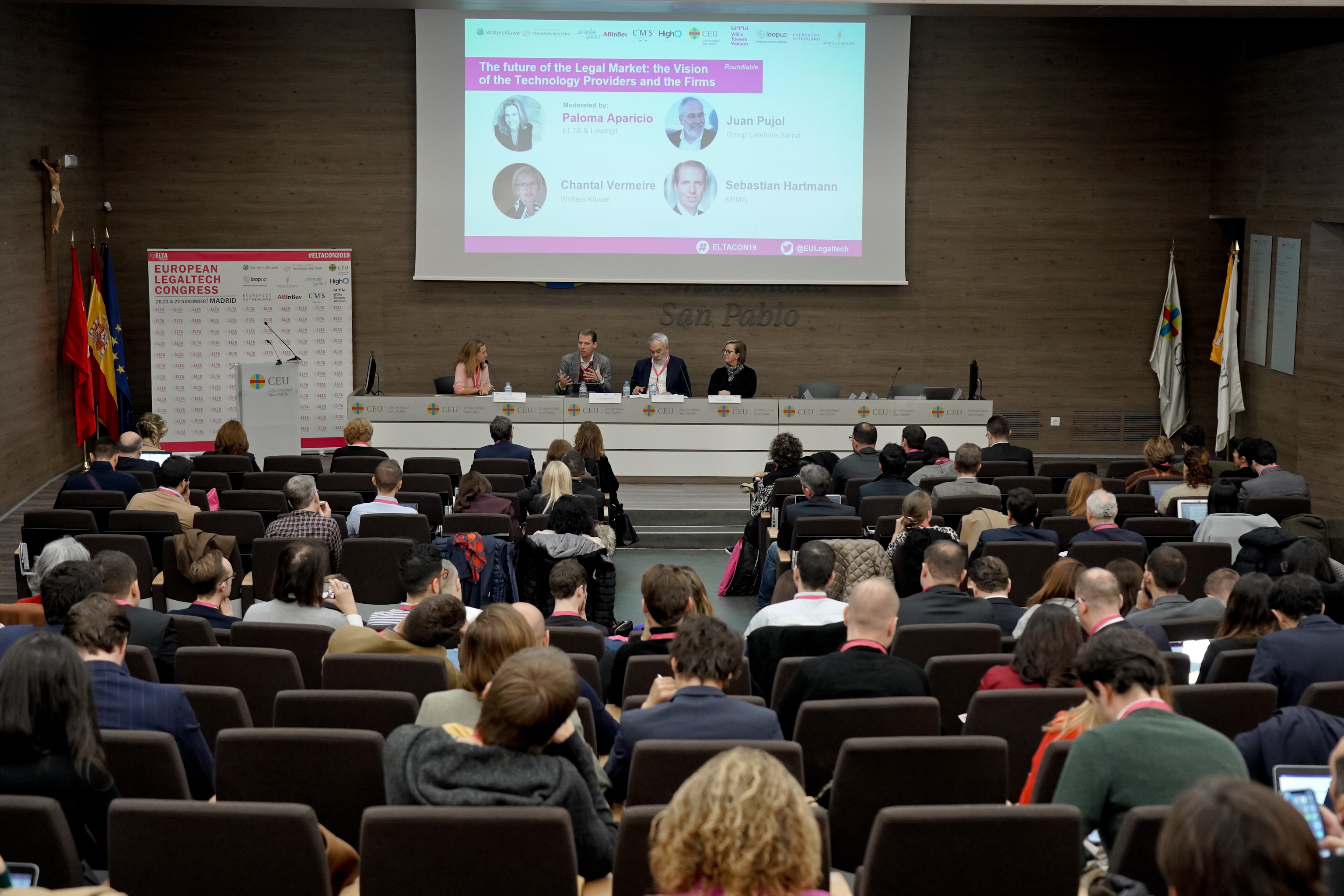
In particular, I would like to mention the roundtable that I had the honour of moderating and highlight, among others, two inspiring phrases on the future of the legal market. The "commitment to collaborative intelligence" of Juan Pujol of Group Lefebvre Sarrut, and the blunt statement of Chantal Vermeire of Wolters Kluwer: "technology is a key enabler for legal professionals to be future ready".
In addition, it is worth highlighting the panel moderated by Caroline Chetrit, also organizer of the Congress, in which the three speakers, the three women! Veronika Voinovian, Orsolya Görgenyi and Caroline Hill, surprised us with new and different opinions and points of view of everything said up to that moment. It's an achievement to be innovative in the midst of so much talent.
The day ended with a reception and a Spanish wine in the ICAM Library, where beers courtesy of AbInBev and wine Denomination of Origin Montilla Moriles were tasted. Building community and relationships in an eminently technological world remains essential and there were sponsors such as LoopUp or Willis Towers Watson who preferred these moments to interact with ELTA members, the public and speakers.
Friday, November 22nd, was the second day of the Congress, on the same stage, but with a different format. The opening was made by representatives of the public sector, Mario Hernández Ramos, Advisor to the Cabinet of the Minister of Justice of Spain and Anabela Pedroso, Secretary of State for Justice of Portugal. The first advocated the balance between technology and security, the second proved to be a passionate and an activist to bring the future closer to the present (I think we all were envious).
From there, representatives of several innovation initiatives, digital transformation and implementation of LegalTech solutions had the occas
Let's close with:
Two tips: from Sebastian Bos of HighQ, "follow the correct order, 1st people, 2nd processes and 3rd technology" and from Jim Leason of Thomson Reuters, "map processes and reimagine the way of working",
One less myth, according to Jose Ángel Sandín of the Lefebvre Sarrut Group, "lawyers are open to innovation".
And, a mandate from Bahar Ansari of 2nd Law & Case One, "stop talking and apologizing. It's time to take action."
From my side, I would like to thank María Jesús González Espejo of the Instituto de Innovación Legal for inviting me on this adventure and to tell you that it has been a pleasure to share the task with the entire organizing team, including also, Caroline Chetrit of Consulegis, Daniel Bermejo of the Instituto de Innovación Legal and Tobias Heining and Julia Brünjes of ELTA.
If you want to know more, contact me at info@lawingit.com
Translated with www.DeepL.com/Translator (free version)